The dynamic groundwater regime across Simcoe County, where the Kempenfelt Bay shoreline meets dense glacial till deposits, creates unique challenges for deep excavation support in Barrie. Water table depths fluctuate seasonally between 1.5 and 3.0 meters below grade across much of the city, while the underlying stratigraphy typically presents stiff silty clay tills with occasional sand lenses that can destabilize a borehole during drilling. These conditions demand anchor systems with carefully calculated unbonded lengths, since a bond zone placed in a permeable lens without adequate grout confinement will fail progressively under service loads. The Ontario Building Code references CSA A23.3 for anchor design, requiring a minimum factor of safety of 2.0 on the ultimate bond stress for permanent installations. For temporary shoring along Bradford Street or deeper cuts near the Royal Victoria Regional Health Centre expansion, we verify tendon capacity against both tensile yield and soil-grout interface rupture modes, using site-specific bond stress values derived from pull-out tests rather than relying on generic correlations from CPT data alone.
Anchor bond length calculations in Barrie's glacial till must account for the reduction in grout-to-ground bond stress when drilling through cobble-rich horizons.
Process and scope
Site-specific factors
Barrie sits at an elevation of approximately 252 meters above sea level, with its urban core built on the Simcoe Lowlands where post-glacial lacustrine clays can extend to depths exceeding 30 meters. The 2013 National Building Code of Canada classifies the region within seismic hazard zone Sa(0.2) values of 0.11 to 0.17 g, which is moderate but not negligible for permanent anchor design. More concerning than seismic demand is the long-term creep behavior of the stiff clay till under sustained anchor loads: relaxation tests on similar Lake Simcoe basin clays have documented loss of up to 12% of initial lock-off load over the first 90 days when anchors are stressed beyond 60% of the soil's undrained shear strength. This is why our design methodology limits tendon utilization to 0.55 fpu for permanent installations and specifies a minimum free length of 4.5 meters regardless of geometry, creating enough tendon stretch to absorb small ground movements without significant load fluctuation.
Regulatory framework
CSA A23.3-14 Annex D, NBCC 2015 Part 4, PTI DC35.1-14, ASTM A416/A416M-18
Related services
Bond length verification testing
Site-specific pull-out tests on sacrificial anchors to confirm grout-to-ground bond stress values before production drilling begins. We analyze load-displacement curves to separate elastic tendon elongation from bond zone slip.
Permanent anchor corrosion protection
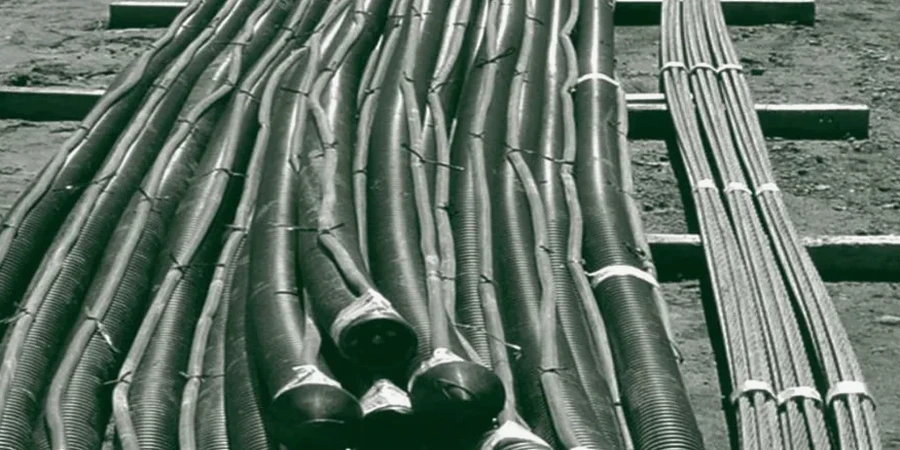
Double-corrosion-protection systems per PTI Class II requirements, including corrugated HDPE sheathing, factory-grouted strand, and watertight encapsulation across the full unbonded length for installations below the fluctuating water table.
Staged excavation and anchor coordination
Sequencing plans that define excavation lift heights, anchor installation windows, and stressing schedules to limit wall deflection below 0.3% of excavation depth, with hold points for load testing before proceeding to the next lift.
Typical parameters
Frequently asked questions
How much does anchor design and testing cost for a typical Barrie excavation project?
For a typical retaining structure requiring 15 to 25 anchors with full design, load testing, and inspection, project costs range from CA$1,430 to CA$4,830 depending on the number of verification tests, access constraints, and whether permanent corrosion protection is required.
What is the difference between active and passive ground anchors?
Active anchors are stressed to their design lock-off load immediately after installation, applying a pre-compression force to the retained soil mass. Passive anchors are installed without prestressing and only develop resistance as the wall moves and engages the tendon. Active systems control wall deflection more tightly, while passive systems are simpler and often used in rock where deformation is minimal.
How deep must the bond zone be placed for anchors in Barrie's glacial till?
The bond zone must extend at least 4.5 meters beyond the theoretical active failure wedge to ensure full embedment in stable soil. In Barrie's stiff clay till, preliminary bond lengths typically range from 6 to 10 meters, but final dimensions are confirmed through on-site pull-out testing to validate the grout-to-ground interface capacity before production drilling. More info.