That steep lot on Rose Street looked like a bargain until the excavation began. The contractor cut into the slope behind the foundation, and within 48 hours a tension crack opened up along the crest, running parallel to the property line. That is the kind of scenario we get called to remediate when a retaining wall design in Barrie gets overlooked during planning. The city sits on a mix of glacial till, silty clay, and sand lenses that drain unpredictably, and when you add the freeze-thaw cycles that chew through conventional masonry every spring, the engineering demands something more deliberate than a standard gravity block wall. A proper slope stability analysis becomes essential the moment your cut exceeds 1.2 meters in this geology, because the clay here loses strength fast when saturated and the setback from the top-of-slope determines whether your wall functions as a retaining structure or just a decorative veneer waiting to tilt.
A retaining wall in Barrie clay that survives five freeze-thaw seasons without distress has earned its engineering pedigree.
Process and scope
Site-specific factors
Barrie sits at 252 meters above sea level, but the real number that matters for retaining wall design is the 1.5-meter frost penetration depth specified in the Ontario Building Code for this region. When the ground freezes that deep, the soil behind a wall swells, and the wall itself becomes a rigid inclusion in a moving mass of ice-locked earth. Walls that are not founded below frost depth get lifted incrementally each winter, and by year five the top-of-wall alignment looks like a sine wave. Beyond frost, the seismic hazard in Barrie is not negligible; the NBCC 2020 assigns a short-period spectral acceleration of about 0.24 to 0.31 g across the city, which means any wall retaining more than 1.8 meters of soil must be checked for seismic earth pressures using the Mononobe-Okabe method. Combine that with the soft clay deposits along the Lake Simcoe shoreline, and you have a recipe for bearing capacity failure at the toe if the foundation is not widened or replaced with a granular pad.
Regulatory framework
NBCC 2020 (National Building Code of Canada, seismic provisions), CSA A23.3:2019 (Design of Concrete Structures), ASTM D698 / D1557 (Proctor compaction for backfill control)
Related services
Cantilever and Gravity Retaining Wall Engineering
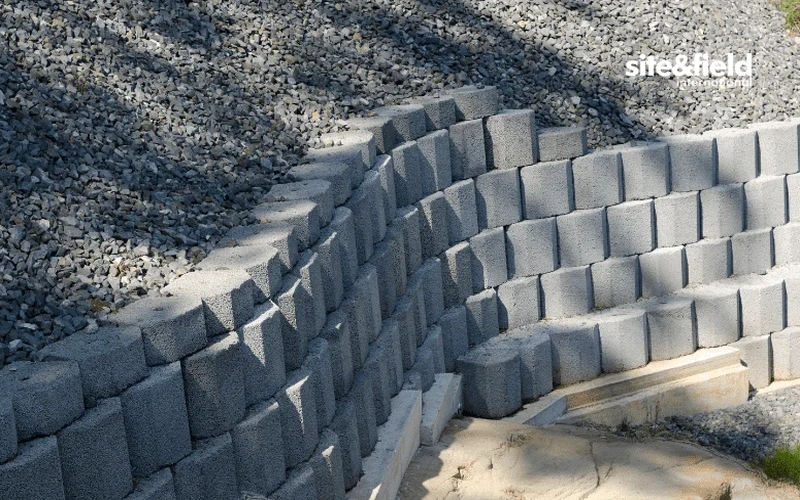
Full structural design of reinforced concrete cantilever walls, gravity block walls, and mechanically stabilized earth (MSE) systems. We size the stem, heel, and toe based on active earth pressure distributions, check overturning and sliding stability, and specify reinforcement per CSA A23.3. For Barrie sites with tight access, we coordinate segmental block deliveries that do not require crane staging on neighboring properties.
Drainage and Frost Protection Design
Design of behind-wall drainage systems including chimney drains, geocomposite sheets, perforated collector pipes, and outlet details that prevent ice blockage. We specify frost protection measures—rigid insulation boards, extended footings, or granular pads—based on the Ontario Building Code frost depth requirements and the specific clay moisture content at your site.
Typical parameters
Frequently asked questions
What does retaining wall design cost for a residential project in Barrie?
For a typical residential retaining wall in Barrie, engineering design fees range from CA$1,450 to CA$5,060 depending on wall height, soil conditions, and whether a grading plan or building permit submission is included. A simple 1.5-meter wall with good gravel soils on a flat lot sits at the lower end; a 3-meter wall on clay with drainage design, structural drawings, and permit coordination moves toward the upper end.
Do I need a building permit for a retaining wall in Barrie?
The City of Barrie requires a building permit for any retaining wall exceeding 1.0 meter in height measured from the bottom of the footing to the top of the wall, or any wall supporting a surcharge such as a driveway or building. Walls under 1.0 meter generally do not need a permit but must still be built on stable ground and not divert water onto adjacent properties. Our drawings include the stamped engineering calculations that the city reviews as part of the permit package.
How long does the design process take from site visit to stamped drawings?
For a straightforward residential wall, we typically deliver stamped design drawings within 10 to 14 business days after the site investigation is complete. The site investigation itself—which includes a test pit or borehole to confirm soil stratigraphy and groundwater depth—usually takes one morning on site. More complex commercial walls with shoring or tieback elements may extend the design timeline to three or four weeks.