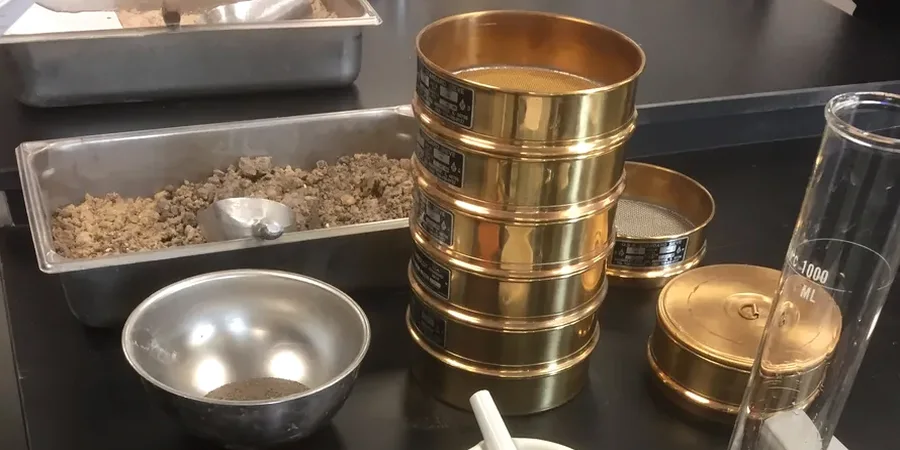
The soil beneath Barrie tells two very different stories. Near the Kempenfelt Bay shoreline, post-glacial lacustrine deposits dominate: fine silty sands and soft clays that can hold water and complicate compaction. Move south toward the Ardagh Bluffs or east to the Oro Moraine, and you encounter dense glacial tills with a wide mix of particle sizes, from clay to cobbles. A complete grain size analysis, combining both sieve and hydrometer methods, is how we distinguish these materials accurately. For the sandy bay deposits, the sieve analysis defines sand gradation and the fines content that controls drainage. For the till, the hydrometer reading reveals the clay fraction that governs plasticity. Our lab processes samples from across Barrie daily, and we often pair the grain size work with Atterberg limits when the fines percentage exceeds 12%, a common scenario in the city's central lowlands.
In Barrie's glacial tills, a 5% difference in clay content measured by hydrometer can change the soil classification from silty sand to clayey sand, altering the entire foundation design.
Process and scope
Site-specific factors
Our hydrometer setup in the Barrie lab runs 24 cylinders simultaneously in a controlled water bath at 20°C. The risk of a bad reading usually starts at the sampling stage, not the equipment. A sample taken from the truck without quartering can over-represent the coarse fraction, making the soil look more granular than it is. Worse, using tap water instead of distilled water for the hydrometer test introduces ions that flocculate the clay particles, causing them to settle faster and report a falsely low clay percentage. In Barrie's glacial deposits, where the clay fraction is often borderline for swelling potential classification, a 3% error can mean the difference between a low-risk and moderate-risk designation. We run a blank hydrometer cylinder with dispersing agent only in every batch to cancel out density shifts from temperature fluctuations. If the sample contains organic material, we pre-treat with hydrogen peroxide before the hydrometer analysis to remove the organic fraction that would float and skew the readings.
Regulatory framework
ASTM D422-63(07), ASTM D6913-04(09), AASHTO T 88-19, ASTM D7928-17
Related services
Complete Particle Size Distribution
Combined sieve and hydrometer test following ASTM D422 and D6913. We report the full gradation curve from coarse gravel to clay colloids, plus the uniformity coefficient (Cu) and coefficient of curvature (Cc). Essential for USCS and AASHTO classification of Barrie's variable glacial and lacustrine soils.
Fines Content and Clay Fraction Analysis
Focused determination of percent passing No. 200 sieve and detailed hydrometer analysis for silt and clay fractions. We use this data to support liquefaction assessments and to specify the correct filter material for drainage systems in Barrie's high-water-table zones near the bay.
Typical parameters
Frequently asked questions
Why do I need both a sieve analysis and a hydrometer test for my Barrie site?
Barrie's soil profile often contains layers that are predominantly sand overlying silty clay deposits. The sieve analysis covers particles larger than 75 microns (sand and gravel), but cannot differentiate between silt and clay below that size. The hydrometer test measures the sedimentation rate of fine particles to quantify the silt and clay fractions separately. Knowing the clay percentage is critical because it controls the soil's plasticity, shrink-swell potential, and drainage behavior. A sieve-only report from a site near the waterfront might describe 30% fines without specifying how much is clay, leaving the geotechnical engineer with an incomplete picture for foundation design.
How long does a full grain size analysis take in your lab?
A standard combined sieve and hydrometer analysis typically requires 3 to 5 business days from sample receipt for a single specimen. The hydrometer portion alone takes a minimum of 24 hours because we record readings at specific time intervals (2, 5, 15, 30, 60, 240, and 1440 minutes). Rush service with a 48-hour turnaround is available for active construction sites in Barrie, but the final hydrometer reading at 24 hours is a hard lower limit for reliable data. Sample preparation time—drying, washing, and splitting—adds to the total.
What sample size do you need for the test?
For a combined sieve and hydrometer test on typical Barrie soils, we require approximately 1 to 2 kg of material in a sealed bag. The sample must be representative; we strongly recommend collecting from the auger or split spoon at the depth of interest rather than from the spoil pile. For the hydrometer portion specifically, we only need 50 grams of the minus No. 10 fraction, but we always request the larger mass to ensure we can run a proper sieve stack and have material in reserve if a re-test is required.
What does a grain size analysis cost in Barrie?
A combined sieve and hydrometer analysis in our Barrie lab ranges from $130 to $250 CAD per sample, depending on the number of specimens and whether a full report with USCS classification and gradation curves is included. Volume discounts apply for projects submitting more than 10 samples. The price covers the complete test: drying, washing over the No. 200 sieve, mechanical sieve shaking, and the full 24-hour hydrometer sedimentation procedure with dispersing agent.