Barrie’s expansion from a lakeside trading post into a major distribution hub along Highway 400 has pushed pavement performance requirements well beyond standard municipal specs. The combination of Kempenfelt Bay’s moisture influence, rapid spring thaw cycles, and the steady stream of heavy-goods vehicles moving through the Allandale and south-end logistics clusters means that a poorly designed concrete slab fails long before its design life. Our approach to rigid pavement design starts with the frost-susceptibility classification of the native silty sand till that underlies much of the city, then builds upward through a structurally optimized Portland Cement Concrete layer, dowelled joints, and a stabilized subbase that resists pumping even during the March melt. We also pull data from test pits and grain-size analysis to confirm the subgrade uniformity because Barrie’s glacial stratigraphy can shift from well-drained outwash to plastic silt within a single industrial lot.
A properly dowelled joint in a Barrie winter transfers 80 percent of the load to the adjacent slab even when the concrete contracts by 4 millimeters.
Process and scope
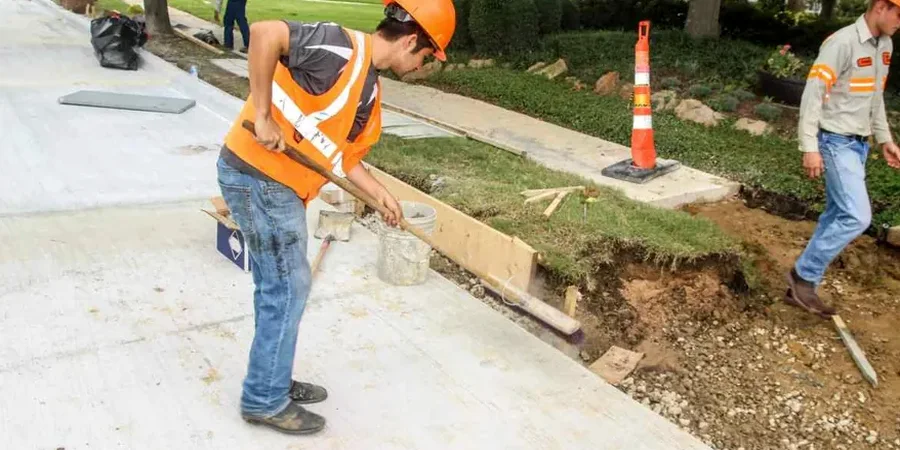
Site-specific factors
The glaciolacustrine silts and clays deposited by glacial Lake Algonquin blanket much of Barrie’s lower elevations, creating a subgrade that loses bearing capacity rapidly when saturated during the spring freshet. If a rigid pavement is built directly on this material without a positive-drainage base layer, pore pressure accumulates beneath the slab and triggers mud-pumping at the joints, eroding the subbase within the first two winters. Thermal curling stress at the slab corners is another hazard: a 200 mm slab in Barrie’s January conditions can lift 1.5 mm at the edge, concentrating traffic loads on a reduced footprint and initiating top-down cracking that propagates before the first maintenance cycle. We model these stresses using finite-element software calibrated to Ontario’s temperature gradient data, then adjust the thickness or add a second layer of reinforcement to keep the stress-to-strength ratio below 0.50 for the design traffic spectrum. Avoiding these failures means treating the pavement not as a single element but as a structural system where the concrete, the steel, the base, and the subgrade all share the work.
Regulatory framework
AASHTO 1993 Guide for Design of Pavement Structures (with Ontario MTO supplemental calibration), OPSS 3502 – Material Specification for Dowel Bars and Tie Bars, ASTM C78 / C78M – Standard Test Method for Flexural Strength of Concrete, CSA A23.1 – Concrete Materials and Methods of Concrete Construction, OPSD 3090 – Ontario Provincial Standard Drawings for Pavement Structures
Related services
Thickness design and fatigue analysis
MEPDG-based modeling that accounts for Barrie’s ESAL projections, thermal gradients, and subgrade k-value to determine the minimum slab thickness required for a 30-year design life.
Joint layout and detailing
Optimization of contraction joint spacing, dowel bar diameter and spacing, tie bar steel for longitudinal joints, and isolation joint design at building interfaces and drainage structures.
Subgrade stabilization and base design
Chemical stabilization of frost-susceptible silts with lime or cement, combined with permeable base layers that maintain drainage even when the ground is partially frozen.
Concrete mix and curing specification
Mix designs that balance workability, strength gain under Barrie’s ambient temperatures, and resistance to de-icing salt scaling, with curing methods that prevent plastic shrinkage cracking during summer pours.
Typical parameters
Frequently asked questions
How much does a rigid pavement design cost for a project in Barrie?
Design fees typically range from CA$2,700 to CA$8,960 depending on the paved area, traffic loading complexity, and whether the scope includes on-site plate load testing and subgrade stabilization recommendations. We provide a fixed-price proposal after reviewing the grading plan and geotechnical report.
When is rigid pavement a better choice than asphalt in Barrie?
Concrete becomes the preferred option when the facility handles heavy, channelized truck traffic, such as loading docks, waste collection pads, or bus terminals, where asphalt would rut within a few seasons. It also performs better in areas with poor drainage because it does not soften with prolonged moisture exposure the way asphalt-bound layers do.
How do you prevent cracking from Barrie winter freeze-thaw cycles?
The primary defense is a well-drained base course that keeps water away from the subgrade, combined with an air-entrained concrete mix with a water-cement ratio below 0.45. Joint spacing is shortened when the coarse aggregate has a high coefficient of thermal expansion, and we specify curing compounds that allow the slab to gain strength gradually before the first freeze.