The 2020 National Building Code of Canada (NBCC) sets stringent requirements for seismic design, and in Barrie, where the post-glacial sediments of the Simcoe Lowlands overlay Ordovician bedrock at variable depths, a generic site class assumption often proves dangerously inadequate. Because the city sits near the western edge of the seismically active Western Quebec Seismic Zone, which produced the magnitude 5.0 Val-des-Bois quake felt across the region in 2010, the dynamic response of the deep lacustrine clay and silt deposits demands precise characterization before any base isolation system can be reliably designed. Our laboratory in Barrie supports structural engineers by providing the site-specific shear wave velocity profiles and dynamic soil properties that the NBCC requires when the fundamental period of an isolated structure shifts into a range where soft clay amplification becomes critical. The process typically begins with field testing through MASW surveys to establish the Vs30 profile and identify impedance contrasts, followed by seismic refraction lines where bedrock depth mapping is needed for the geotechnical model. We routinely see that the greatest design risk is not the isolation hardware itself but rather underestimating the spectral acceleration values when the underlying Leda clay, a sensitive marine deposit common to the Barrie area, governs the site response.
In Barrie's deep post-glacial clays, the difference between a generic damping ratio of 5% and a measured one of 8% can alter the isolator displacement demand by more than 30% in the nonlinear time-history analysis.
Process and scope
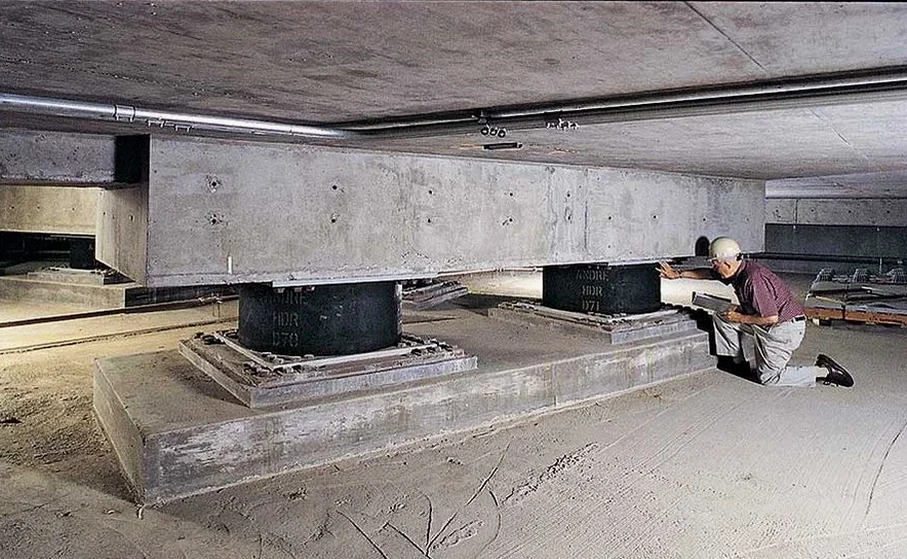
Site-specific factors
Barrie’s population of over 150,000 continues to expand along the waterfront and into the annexed lands of the former Innisfil boundary, placing critical infrastructure on the deep compressible soils of the Lake Simcoe basin. The greatest seismic hazard for an isolated structure in these conditions arises not from the moment magnitude of a distant event but from the basin-edge effects that trap and amplify long-period energy exactly in the range where base-isolated buildings are most sensitive. When the impedance contrast between the dense till and the overlying soft clay is steep, as mapped extensively in the downtown corridor near Kempenfelt Bay, the two-dimensional site effects can produce spectral ordinates at 2.0 to 3.0 seconds that exceed the NBCC uniform hazard spectrum by a significant margin. A base isolation design that relies solely on the code spectrum without a site-specific response analysis performed on a calibrated soil column risks underestimating the displacement demand and the isolator shear strain, which in lead-rubber bearings translates directly into reduced energy dissipation per cycle and potential instability at large lateral offsets. We integrate the laboratory-derived modulus reduction and damping curves into a one-dimensional equivalent-linear or nonlinear wave propagation analysis using profiles constrained by the MASW survey, ensuring that the ground motion input for the structural model reflects the actual resonance characteristics of the Barrie subsurface rather than a conservative but inaccurate code default.
Explanatory video
Regulatory framework
NBCC 2020 (Division B, Part 4), ASTM D4015-21 (Resonant Column), ASTM D5311/D5311M-13 (Cyclic Triaxial), ASTM D4428/D4428M-14 (Crosshole/MASW), CSA A23.3-19 (Concrete structures, complementary)
Related services
Dynamic Soil Property Testing
Resonant column and cyclic triaxial tests on undisturbed Barrie clay specimens to measure G/Gmax and damping ratio curves from small to high shear strains, with consolidation stresses replicating the in-situ effective stress profile for each layer.
Site-Specific Ground Response Analysis
One-dimensional nonlinear or equivalent-linear wave propagation modeling using DEEPSOIL or equivalent software, calibrated with our laboratory data, to generate surface response spectra and acceleration time histories for the isolator design.
Vs30 and Seismic Site Classification
Multi-channel analysis of surface waves (MASW) and seismic refraction surveys to determine the average shear wave velocity in the upper 30 meters and assign the NBCC site class, with spatial mapping across the building footprint to detect lateral variability.
Geotechnical Characterization for Isolation Foundation
Integrated field exploration combining SPT drilling, CPT soundings, and Shelby tube sampling to define the stratigraphy, strength, and consolidation properties of the soils supporting the isolation bearing pads and the foundation elements.
Typical parameters
Frequently asked questions
How much does a base isolation seismic design study cost for a project in Barrie?
For a typical building project in Barrie, the combined field investigation, dynamic laboratory testing, and site response analysis for base isolation design ranges between CA$5,290 and CA$12,980, depending on the number of isolators, the depth of the soft clay profile, and the number of soil layers requiring resonant column and cyclic triaxial testing.
What dynamic properties does the NBCC require for base isolation design?
The NBCC 2020 requires that the site-specific design spectrum account for the dynamic amplification characteristics of the underlying soils when a base isolation system is used, which means the shear modulus reduction and damping ratio curves must be measured on representative undisturbed samples rather than adopted from generic correlations, especially for site classes D and E common in Barrie.
Why is base isolation particularly relevant for Barrie's soil conditions?
Barrie's subsurface is dominated by deep deposits of glaciolacustrine clay and silt that exhibit a strong impedance contrast with the underlying till and bedrock, creating a resonant column effect that amplifies long-period ground motion; base isolation shifts the structural period into this amplified range, so accurate characterization of the site period and damping is critical to avoid resonance rather than mitigation.
What is the difference between a code spectrum and a site-specific spectrum for Barrie?
The NBCC uniform hazard spectrum assumes a reference ground condition, but a site-specific response analysis using Barrie-measured dynamic properties accounts for the actual stratigraphy, the modulus degradation at each layer, and the basin geometry effects near Lake Simcoe, often producing spectral accelerations at periods above 1.5 seconds that differ by 20 to 40 percent from the code values.