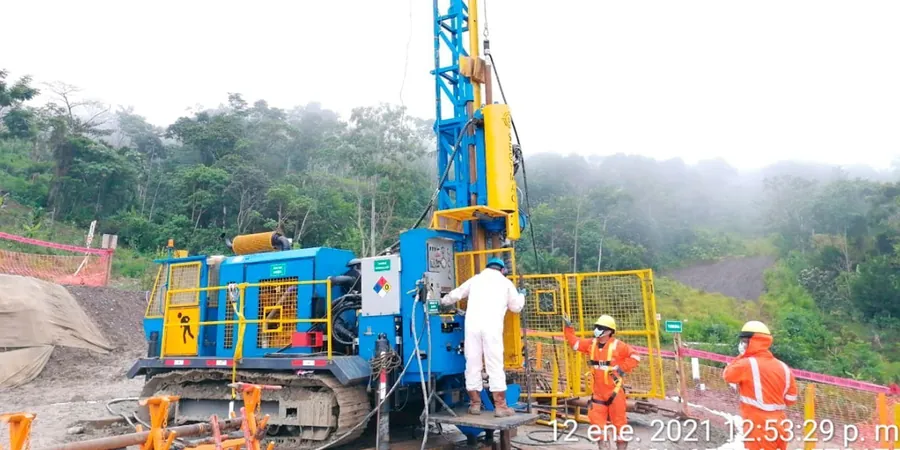
The rig sits on a compact track carrier, a 140-pound safety hammer lifting and dropping with mechanical precision. In Barrie, the split-spoon sampler drives through dense glacial till and layered lacustrine clays, recording blow counts every six inches. That hammer energy matters here, where the NBCC 2020 governs seismic design and the local stratigraphy shifts from sandy outwash near Kempenfelt Bay to stiff silt deposits further inland. We run every Standard Penetration Test with an automatic trip hammer calibrated to ASTM D1586-18, because N-values uncorrected for energy ratio can mislead a foundation design by 20 percent or more. When the sampler comes up with a Shelby tube sample from a softer clay layer, we flag it for Atterberg limits before the report leaves the office.
Corrected N60 values in Barrie's glacial sediments often differ from raw field counts by 30 percent or more, depending on overburden pressure and hammer energy.
Process and scope
Site-specific factors
The frost cycle in Barrie reaches 1.5 meters deep, and the spring thaw turns silty overburden into a saturated sponge. We have seen boreholes where the groundwater table rises three meters between February and April, completely changing the effective stress regime. Running an SPT in these conditions without noting the water level and stabilization time produces N-values that look higher than they really are, because the pore pressure hasn't dissipated. The real risk shows up later, when the excavation hits that water-bearing silt and the contractor loses the bottom of the footing. On the Lake Simcoe shoreline, we also watch for organic silt lenses that compress under load, a hazard that raw blow counts alone won't flag. That is why we always log the recovery, the color, and the odor of every spoon sample.
Regulatory framework
ASTM D1586-18, NBCC 2020 (Division B, Part 4), CSA A23.3-19
Related services
Geotechnical SPT Drilling
Track-mounted rigs accessing tight urban lots and lakeside properties. We log every spoon recovery, run field vane tests in soft clay, and deliver corrected N60 profiles with soil descriptions. Reports include liquefaction screening where the NBCC seismic hazard index exceeds 0.12.
Foundation Parameter Reports
From the SPT data we calculate allowable bearing capacity using Meyerhof and Bowles methods, estimate settlement in granular and cohesive layers, and recommend footing depths that account for Barrie's frost penetration zone. Each report references the specific borehole coordinates and groundwater observations.
Typical parameters
Frequently asked questions
How much does an SPT investigation cost for a typical Barrie residential lot?
For a single-family lot in Barrie, an SPT program with two to three boreholes typically ranges from CA$850 to CA$1,180. The final figure depends on access, depth, and whether we need to add laboratory testing like grain size or Atterberg limits on the recovered samples.
What depth do you drill for SPT boreholes in the Barrie area?
Most residential and low-rise commercial boreholes in Barrie go to 10 or 12 meters. For taller structures or sites near the lake where compressible layers are suspected, we extend to 20 or 25 meters. The NBCC requires investigation depth to reach a stratum with adequate bearing or to prove that settlement will be acceptable.
How do you handle groundwater in Barrie SPT boreholes?
We record the water level at the start of each day and after the hole is completed, letting it stabilize for at least 20 minutes in sandy soils and longer in silt. If the water is high, we note it on the log and apply the appropriate effective stress correction to the N-values before calculating bearing capacity.