Barrie’s surficial geology is dominated by thick glaciolacustrine deposits from glacial Lake Algonquin, creating extensive layers of silty clay and clayey silt across the city’s expanding suburbs. These fine-grained soils are highly sensitive to moisture changes, and their behavior during excavation or foundation loading depends directly on the Atterberg limits. The liquid limit in Barrie clays often ranges between 35 and 55 percent, while the plasticity index can exceed 20 percent, indicating moderate to high plasticity that demands careful classification. When developers break ground near Kempenfelt Bay or along the Highway 400 corridor, knowing the soil’s consistency limits prevents costly misjudgments about bearing capacity and settlement. Our laboratory performs Atterberg limits testing according to ASTM D4318, providing the liquid limit, plastic limit, and plasticity index values that feed directly into the Unified Soil Classification System and regional geotechnical models.
A plasticity index above 20 percent in Barrie glaciolacustrine clays signals a soil that will change volume significantly with seasonal moisture fluctuations.
Process and scope
Site-specific factors
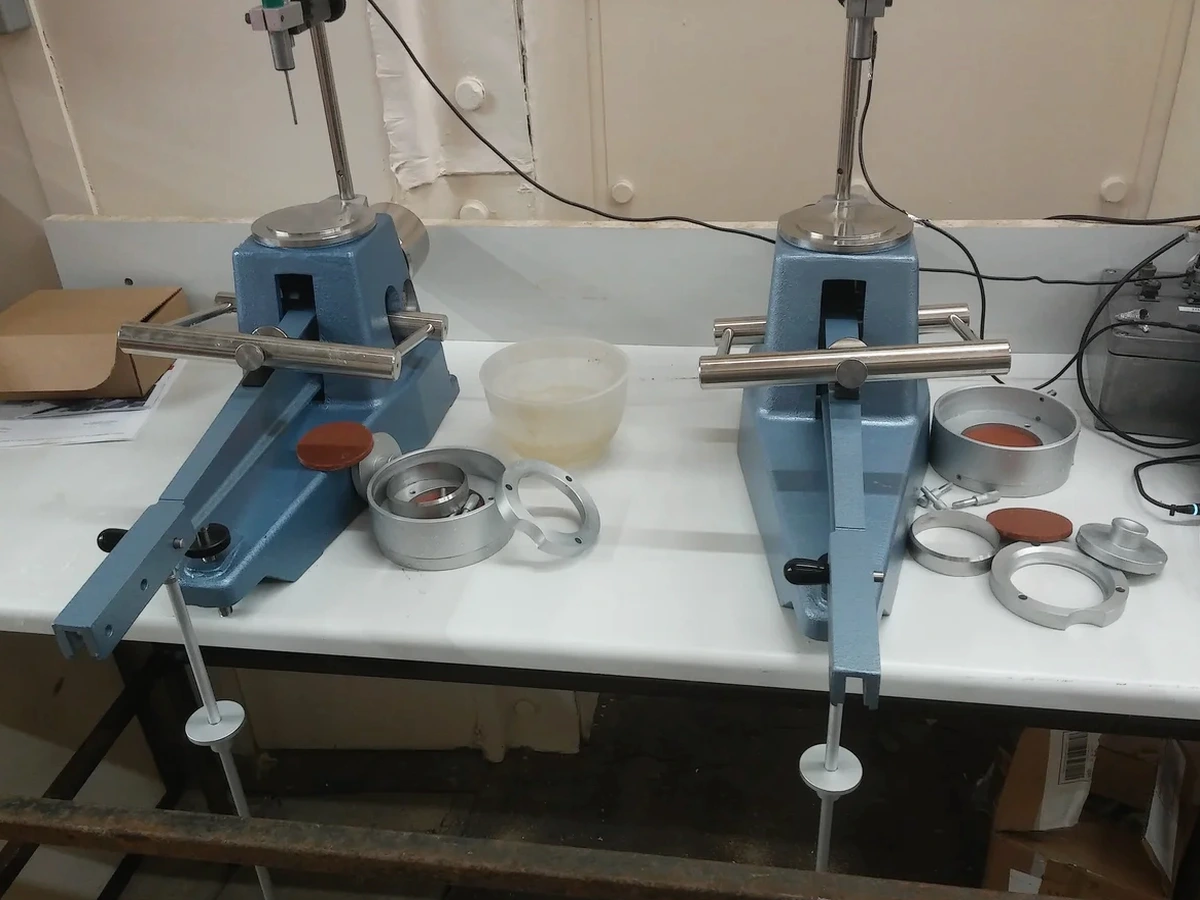
The standard Casagrande liquid limit device and the manual thread-rolling method for plastic limit remain the reference procedures in the Barrie soil lab, despite the availability of automated alternatives. Technicians cut a groove in the soil pat using the ASTM grooving tool, count the blows required to close the groove over 13 millimeters, and repeat at multiple moisture contents to construct the flow curve. Plastic limit testing requires rolling 3-millimeter threads of soil until they crumble, a technique that depends heavily on consistent operator technique. For Barrie’s varved clays, which alternate between silt laminae and clay layers, obtaining a representative sample demands careful homogenization before testing. Misclassification of a high-plasticity clay as silt can lead to underestimating frost heave potential in Barrie’s freeze-thaw climate, where winter temperatures routinely drop below minus 20 degrees Celsius.
Regulatory framework
ASTM D4318-17e1 Standard Test Methods for Liquid Limit, Plastic Limit, and Plasticity Index of Soils, ASTM D2487-17 Standard Practice for Classification of Soils for Engineering Purposes (Unified Soil Classification System), NBCC 2020 Division B, Part 4 (seismic site classification referencing soil plasticity)
Related services
Comprehensive Atterberg Limits Suite
Determination of liquid limit using the Casagrande cup method or fall cone, plastic limit by thread rolling, and calculation of the plasticity index. Results are reported in accordance with ASTM D4318 and support USCS classification for Barrie's glaciolacustrine clays.
Soil Classification and Correlative Analysis
Pairing Atterberg limits with grain size distribution and natural moisture content to assign USCS group symbols, assess swell potential, and evaluate the suitability of Barrie soils for engineered fill or subgrade applications.
Typical parameters
Frequently asked questions
What do Atterberg limits tell me about the soil on my Barrie building lot?
The liquid limit and plastic limit define the moisture content range where the soil behaves as a plastic solid. In Barrie’s glaciolacustrine clays, a plasticity index above 20 percent indicates a soil that will shrink when dry and swell when wet, which can damage shallow foundations and slab-on-grade construction. The results also assign a USCS group symbol such as CL or CH, which engineers use to determine allowable bearing pressure and excavation stability.
How much does Atterberg limits testing cost for a Barrie project?
For a standard Atterberg limits suite covering liquid limit, plastic limit, and plasticity index on one sample, the cost ranges between CA$100 and CA$140 depending on the number of flow curve points required and the sample preparation effort. Multi-sample projects or rush turnaround may adjust the final pricing.
How many samples are needed for reliable Atterberg classification on a Barrie site?
The number depends on site stratigraphy. For a typical Barrie lot with 3 to 5 meters of glaciolacustrine clay over till, we recommend at least one sample per distinct soil layer encountered in the borehole or test pit, with additional samples taken at the proposed footing elevation and at any layer showing visible varving or organic staining.