The contrast between Barrie's north-end developments on the Oro Moraine and the lakeside projects near Kempenfelt Bay makes foundation design anything but uniform here. The moraine gives you dense, overconsolidated till, but shift toward the bay and you encounter loose, saturated silty sands deposited by glacial Lake Algonquin—soils that scream for deep densification before any structural load touches the ground. Vibrocompaction design in Barrie addresses exactly this variability, using depth-controlled vibration to rearrange grains into a denser state without excavating or replacing material. When you combine this with a CPT test to map the loose zones before treatment, the design becomes far more precise, and the post-treatment verification leaves no room for guesswork.
In Barrie's postglacial deposits, vibrocompaction design succeeds or fails on the accuracy of the fines content profile—anything above 15% silt demands a fundamentally different densification strategy.
Process and scope
- Real-time amperage monitoring during probe penetration and extraction
- Pre- and post-treatment CPT or SPT verification at each cluster
- Adaptive grid adjustment when encountering unexpected silt lenses
- Water jetting parameters tuned to local groundwater chemistry to avoid probe clogging
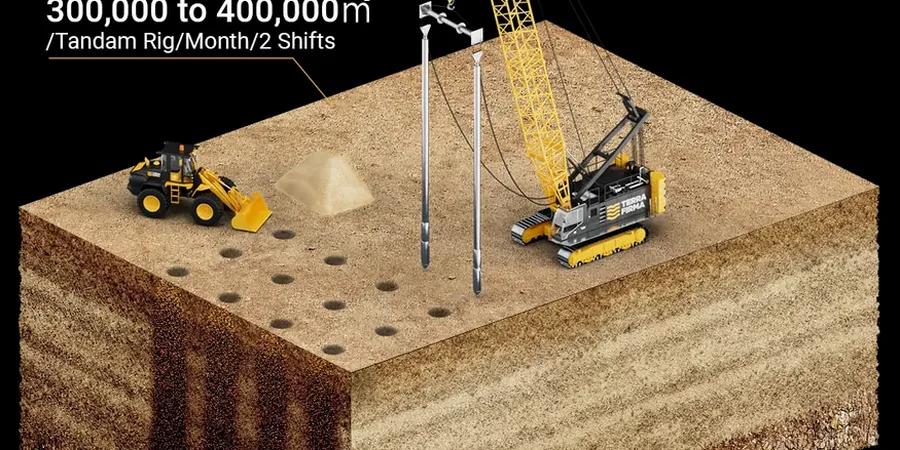
Site-specific factors
A mid-rise residential building on Bradford Street, just south of the downtown core, encountered a loose sand layer at 7 meters that had never been properly identified during the preliminary investigation. The original design called for shallow footings on engineered fill, but the site-specific seismic assessment under NBCC 2015 showed a liquefaction susceptibility that would have triggered differential settlements exceeding 45 mm during the design earthquake. Vibrocompaction design for Barrie projects like this one requires integrating the city's moderate seismicity—peak ground acceleration around 0.12g on firm ground—with the real stratigraphy. The loose sand was treated with a 2.1-meter triangular grid over the entire footprint, verified with five post-treatment CPT soundings, and the measured tip resistance increased by a factor of 3.8. Without that intervention, the foundation would have required a complete redesign to deep piles, adding months and a significant cost premium to the project.
Explanatory video
Regulatory framework
NBCC 2015 (seismic hazard and foundation design), ASTM D6066-11 (Standard Practice for Determining the Normalized Penetration Resistance of Sands for Evaluation of Liquefaction Potential), CSA A23.3-14 (Design of Concrete Structures, relevant for post-treatment foundation elements), ASTM D5778-20 (CPT standard, for pre- and post-treatment verification), Youd et al. (2001) NCEER/NSF liquefaction evaluation guidelines
Related services
Pre-Treatment Site Characterization
CPT and SPT campaigns targeting loose sand lenses in the Barrie area, with lab testing for grain size distribution and fines content to confirm soil suitability for vibratory densification.
Vibrocompaction Design Package
Grid layout, energy input specifications, probe depth versus amperage curves, and acceptance criteria based on target relative density and post-treatment tip resistance thresholds.
Post-Treatment Verification Testing
Repeat CPT or SPT at specified locations within the treatment grid, comparison with pre-treatment baselines, and signed compliance report referencing ASTM D6066 and project-specific performance criteria.
Typical parameters
Frequently asked questions
How long does a vibrocompaction treatment typically last on a Barrie site?
For a standard residential or commercial lot covering 800 to 1500 square meters, the vibrocompaction work itself usually takes 3 to 5 working days. That includes mobilization, treatment of the grid, and initial verification testing. The schedule can stretch if we encounter thicker silt layers that require drainage pauses or if winter conditions freeze the upper crust—something we see in Barrie between December and March.
What is the typical cost range for vibrocompaction design and treatment in Barrie?
The combined design and treatment cost for a typical Barrie project falls between CA$1,780 and CA$6,660, depending on the treatment depth, grid density, and the number of verification soundings required. Deeper treatment beyond 12 meters or tight grids below 1.8-meter spacing push toward the upper end of that range.
Can vibrocompaction be used near existing structures in downtown Barrie?
Yes, but with caution. The vibration amplitudes generated by the probe attenuate with distance, and we typically maintain a minimum setback of 5 to 8 meters from sensitive structures or buried utilities. For closer work, we pre- and post-survey the adjacent buildings for settlement and vibration monitoring, and in some cases switch to a stone column solution if the risk to neighboring foundations is unacceptable.
How do you verify that the densification actually worked?
We use a combination of pre- and post-treatment CPT soundings at the same locations within the grid. The increase in cone tip resistance directly correlates with relative density gain. For Barrie projects, we also run grain size checks on samples taken before treatment, because the presence of fines above 15% changes the expected tip resistance curve and requires a different acceptance criterion based on excess pore pressure dissipation rather than purely mechanical densification.
Does vibrocompaction eliminate liquefaction risk completely?
It reduces the risk to an acceptable level defined by the project's performance criteria, but 'completely' is not an engineering term we use. Under the NBCC and ASTM D6066 framework, we target a factor of safety against liquefaction of 1.3 or higher for the design earthquake. Post-treatment CPT data confirms whether the treated soil reaches that threshold. In Barrie's moderate seismicity, a well-executed vibrocompaction design typically achieves FoS values well above 1.5, which is considered solid for the design life of the structure.