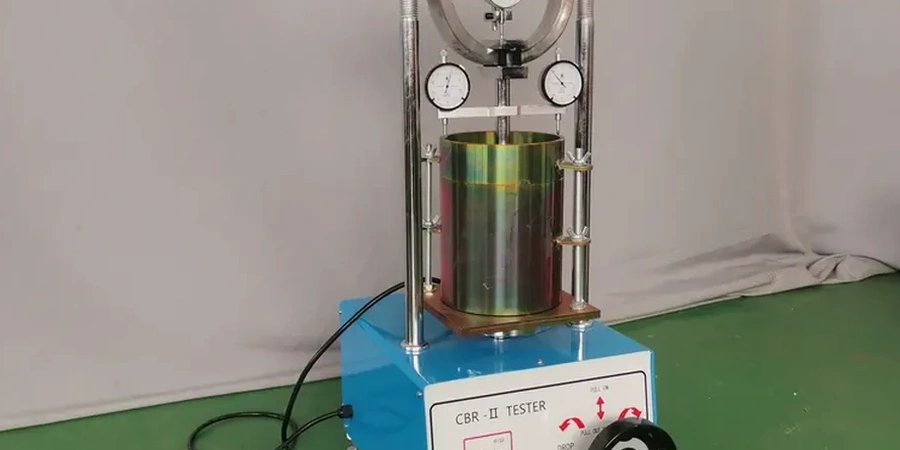
Barrie's rapid expansion—adding over 6,000 new residents between 2016 and 2021—puts real pressure on road infrastructure. Every new subdivision, commercial plaza, and arterial widening in the city rests on a pavement section whose thickness hinges on one number: the CBR. In our lab on the southern edge of Simcoe County, we run soaked and unsoaked California Bearing Ratio tests following ASTM D1883 and AASHTO T-193. The silty clay and glacial till that dominate Barrie's geology behave very differently when saturated, and a dry-weather value alone can mislead a pavement design by 30% or more. We see it often in the Holly and Painswick areas, where spring thaw turns a firm subgrade into a spongy mess within two weeks. Before placing the first lift of granular, we recommend pairing the CBR data with a Proctor test to lock in the compaction target, and for projects near the waterfront, a grain size analysis helps quantify the silt fraction that drives frost susceptibility.
A soaked CBR of 2 versus 6 on the same till can double the required asphalt thickness—no pavement engineer in Barrie ignores that spread.
Process and scope
Site-specific factors
Barrie's winter frost penetrates 1.2 to 1.5 meters into exposed silty soils, and the freeze-thaw cycling from November through April can reduce the effective CBR of a fine-grained subgrade by half compared to its late-summer value. This isn't a lab artifact—it's a direct consequence of ice lens formation and the loss of soil structure upon thawing. If the pavement design relies on an unsoaked CBR measured from a sample taken in August, the spring load restrictions on Essa Road or Ferndale Drive become a predictable annual event. A soaked CBR test in the lab, with 96 hours of full submersion and a swell reading every 24 hours, gives us a conservative lower bound that matches what the road base actually experiences during the worst week of March. For projects where the water table sits within 1 meter of the subgrade, we also recommend the soaked value as the sole design input, not an average of soaked and unsoaked.
Explanatory video
Regulatory framework
ASTM D1883-21, AASHTO T-193-22, ASTM D698-12 (Method A), MTO LS-701, OPSS 501
Related services
Soaked Laboratory CBR
Three-point CBR curve on specimens compacted at optimum moisture and soaked 96 hours. Includes swell versus time plot and corrected bearing ratio at 0.1 in and 0.2 in penetration.
CBR with Proctor Correlation
Standard or Modified Proctor (ASTM D698 or D1557) run on the same sample, then CBR specimens molded at the target density. Delivers a density-CBR envelope useful for compaction specifications.
Troubleshooting Low CBR Soils
When soaked CBR comes back below 2, we run supplemental Atterberg limits and hydrometer analyses to identify the clay mineralogy and silt fraction, then recommend stabilization options for the design engineer's review.
Typical parameters
Frequently asked questions
How much does a laboratory CBR test cost in Barrie?
For a single-point soaked CBR test on one soil type, the fee ranges from CA$180 to CA$300 depending on whether a companion Proctor is also required. A full three-point CBR curve with Proctor typically falls toward the upper end of that bracket.
How long does it take to get CBR results from the lab?
The soaking phase alone takes 96 hours per ASTM D1883. Including sample preparation, compaction, soaking, penetration testing, and reporting, the standard turnaround is 4 to 6 business days. We can expedite the report for an additional charge if the penetration data are already collected.
What soil types in Barrie give the lowest soaked CBR values?
The glaciolacustrine silty clays found in the lower-lying areas near Kempenfelt Bay and the Lovers Creek floodplain consistently produce soaked CBR values between 1 and 3. These soils combine high silt content with moderate plasticity, and the 96-hour soak often triggers measurable swell that further weakens the matrix.
Do you need an undisturbed sample for a lab CBR test?
No. The CBR test is performed on remolded specimens compacted to a specified density and moisture content. We do need a representative disturbed sample—about 45 kg per soil type—taken from the subgrade elevation. The sample can come from test pits, auger borings, or stockpiled excavated material.
Can the lab CBR value be used directly for MTO pavement design in Ontario?
Yes. The Ontario Ministry of Transportation pavement design method accepts laboratory soaked CBR as a direct input for the subgrade strength parameter. We follow MTO LS-701 and OPSS 501 requirements so the reported values integrate seamlessly into a provincial pavement design submission.