A common mistake on Barrie construction sites is assuming that reaching the specified lift thickness automatically guarantees density. The silty sands and clay tills left by the glacial Lake Algonquin plain can appear firm yet remain 8 to 12 percent below modified Proctor maximum dry density—an invisible defect that shows up later as differential settlement under frost action. The Proctor test eliminates this guesswork by establishing the precise moisture-density relationship for the exact borrow source being placed. Whether the spec calls for Standard effort at 600 kN-m/m³ or Modified effort at 2700 kN-m/m³, the laboratory curve becomes the target against which every nuclear gauge reading is judged. In the frost-susceptible soils common across Simcoe County, the sand cone density test provides the field verification that ties field compaction directly back to the lab Proctor reference, creating a closed loop that the geotechnical engineer can sign off with confidence.
A Proctor curve built from the actual pit-run material on your Barrie site removes the single largest source of compaction dispute: the wrong target density.
Process and scope
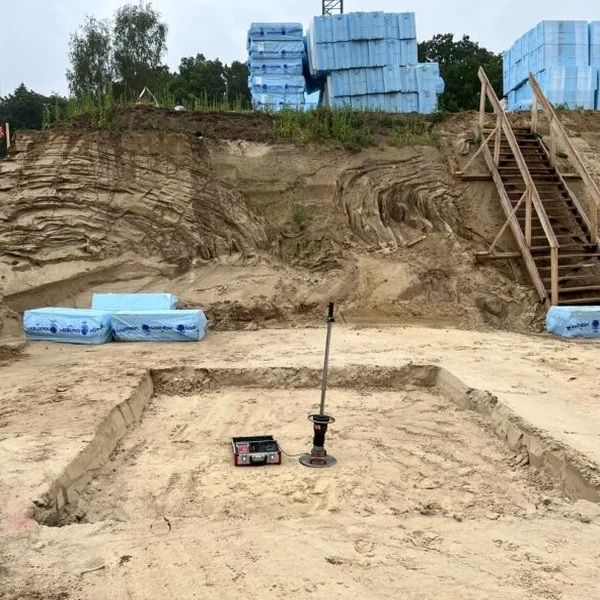
Site-specific factors
The compaction hammer assembly—a 4.54 kg rammer with a 457 mm controlled drop cycling 25 times per layer across five lifts—delivers a repeatable energy input that simulates heavy vibratory roller compaction. Skipping the Proctor and relying on a generic curve from a different borrow source is the fastest route to a failing density test. In Barrie, where granular borrow often comes from the Oro Moraine or the Minesing Swamp perimeter, particle shape and gradation vary enough between pits that a curve developed three concessions away may be off by 3 to 5 percent on maximum dry density. That margin alone can turn a passing fill lift into a failed one—triggering re-rolling, re-testing, and a day lost from the schedule. The cost of the Proctor test is negligible compared to the cost of a compaction dispute between the owner's geotechnical consultant and the earthworks contractor.
Regulatory framework
ASTM D698-12(2021): Standard Test Methods for Laboratory Compaction Characteristics Using Standard Effort, ASTM D1557-12(2021): Modified Proctor, ASTM D2216: Moisture Content, Ontario Provincial Standard Specification OPSS 501 (Compacting)
Related services
Standard Proctor (ASTM D698)
Five-point moisture-density curve using 600 kN-m/m³ compaction effort. Standard reference for landscape fill, utility trench backfill, and non-structural embankments in Barrie subdivisions.
Modified Proctor (ASTM D1557)
Five-point curve at 2700 kN-m/m³ effort. Required for structural fill beneath foundations, floor slabs, parking areas, and any engineered fill where settlement tolerance is tight.
Typical parameters
Frequently asked questions
How much does a Proctor test cost for a Barrie project?
A standard or modified Proctor test typically ranges from CA$150 to CA$250 per sample, depending on whether a single-point or full five-point curve is requested. Expedited turnaround and site sampling add incremental cost. For projects requiring multiple borrow source verifications, volume pricing applies.
How long does it take to get Proctor results?
Standard turnaround is 24 to 48 hours after the sample arrives at the lab. We can provide same-day results when scheduled in advance—particularly useful when the contractor is mobilizing and needs the target density before fill placement begins.
When is Modified Proctor required instead of Standard?
Modified Proctor (ASTM D1557) is specified for structural fill under foundations, slabs, and pavements where higher bearing capacity and lower settlement are needed. Standard Proctor (ASTM D698) governs utility trench backfill, landscaping, and general site grading. The geotechnical report for your Barrie project will state which method applies.
Can you run a Proctor on material with oversize particles?
Yes. When the fill contains gravel or cobbles retained on the 19 mm sieve, we apply ASTM D4718 oversize correction to adjust the laboratory maximum dry density. This correction is critical for many Barrie sites where till-derived borrow contains a significant coarse fraction that would otherwise bias the lab result.