In Barrie, the biggest variable we deal with when designing shallow foundations is the abrupt transition from dense glacial till on the hills to the compressible varved clays that settled at the bottom of ancient Lake Algonquin. The city spans elevations from 175 m near Kempenfelt Bay up to 290 m in the southwest, which means two lots 500 meters apart can sit on completely different bearing strata. Before placing a footing, we drill to confirm whether the till is continuous or if a silty interbed is hiding at 2.5 m depth, because that thin layer governs differential settlement. For sites where the clay is thicker than expected, we often combine the investigation with mat foundations to distribute load over a wider area, and in the till-dominated zones we verify compactness with SPT drilling to justify bearing pressures above 150 kPa.
The bearing capacity of a shallow foundation in Barrie is rarely governed by shear failure; it is almost always the settlement of the varved clay under the desiccated crust that controls the design.
Process and scope
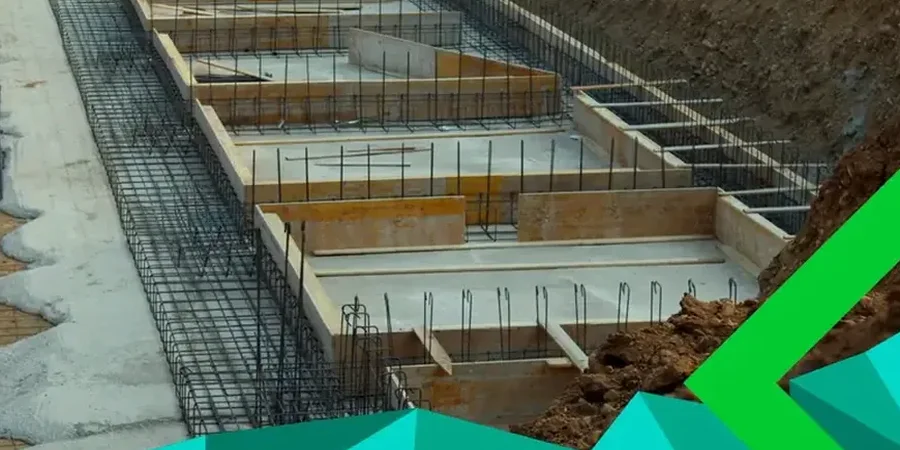
Site-specific factors
The National Building Code of Canada requires that the bearing stratum for a shallow foundation be free of organic material and frozen soil, but in Barrie the practical risk is the presence of isolated pockets of soft silt within the till that go undetected with widely spaced boreholes. These pockets, often remnants of small glacial ponds, can consolidate under load and produce differential settlement exceeding 15 mm across a 6-meter footing line. The CSA A23.3 standard also demands that foundation concrete be protected from sulfate attack, and the groundwater in parts of the city's north end has sulfate concentrations above 150 mg/L, which forces the use of Type HS cement. A secondary hazard is frost jacking of shallow footings placed at less than 1.2 m depth; we have measured frost penetration below 1.0 m during Barrie winters when the snow cover is thin and the wind scours the exposed grade. The combination of frost heave in the crust layer and consolidation of the soft clay below is the mechanism that generates the most serviceability failures we are called to investigate after the first year of occupancy.
Regulatory framework
NBCC 2020 Division B, Section 4.2 — Foundations, CSA A23.3:2019 — Design of Concrete Structures (sulfate exposure classes), ASTM D2435/D2435M — One-Dimensional Consolidation Properties of Soils, ASTM D1586-18 — Standard Test Method for Standard Penetration Test (SPT)
Related services
Bearing capacity evaluation on glacial till
We execute SPT borings to refusal or to a depth of 1.5 times the footing width below the bearing elevation, classifying the till according to the Unified Soil Classification System and assigning allowable bearing pressures per NBCC criteria. We also measure the N-value profile to rule out a soft layer that could trigger a punching failure.
Settlement analysis on varved clay
When the foundation rests on the clay unit, we extract undisturbed Shelby tube samples and perform incremental consolidation tests to generate the e-log p curve. We calculate immediate settlement using elastic theory and consolidation settlement using the compression index, reporting the time rate so the contractor can anticipate post-construction movement.
Frost protection and sulfate attack mitigation
We measure the groundwater sulfate concentration and the soil resistivity to assign the correct exposure class per CSA A23.3, and we specify the minimum embedment depth based on Barrie's design freezing index. For unheated structures, we provide the required thickness of extruded polystyrene insulation under the slab.
Subgrade preparation and proof-rolling specification
We define the compaction requirements for the subgrade and the engineered fill beneath footings and slabs, referencing our Proctor test results. On sites where the crust has been disturbed, we prescribe a proof-rolling procedure with a loaded dump truck to identify soft spots before steel is placed.
Typical parameters
Frequently asked questions
What is the typical cost of a geotechnical investigation for a shallow foundation design on a single-family lot in Barrie?
For a standard residential lot in Barrie, the investigation including two boreholes, laboratory testing of selected samples, and a signed foundation report typically ranges between CA$2,780 and CA$4,580. The final cost depends on access for the drill rig, the depth of the glacial till, and the number of consolidation tests required if varved clay is encountered.
Can I use a thickened-edge slab on grade instead of strip footings in Barrie's clay areas?
Thickened-edge slabs are feasible on the dense glacial till that outcrops in the higher parts of the city, but on the varved clay unit they require careful evaluation. The slab edge concentrates the load on a narrow perimeter, which can exceed the bearing capacity of the soft clay below the crust. We usually recommend a minimum 600-mm-wide footing at the edge to reduce the contact pressure, and we may specify a layer of compacted granular fill to bridge any differential movement.
How deep do footings need to be in Barrie to avoid frost heave?
The NBCC assigns Barrie a design freezing index of approximately 900 °C-days, which translates to a minimum footing embedment of 1.2 m below finished grade for heated structures. For unheated garages or porches, that depth increases to 1.5 m unless rigid foam insulation is installed horizontally around the perimeter. We always confirm the final depth in the report based on the soil type, because silt and fine sand are more frost-susceptible than the clean gravel found in the till.