A four-storey mixed-use building on Dunlop Street East encountered eight metres of soft, glaciolacustrine clay — the kind of deposit that turns routine foundation work into a settlement lawsuit. The structural loads exceeded 180 kPa, but the native clay offered an undrained shear strength barely reaching 35 kPa near the surface. Shallow footings were ruled out within the first hour of the geotechnical review. The solution required vertical inclusions that transfer stress past the compressible zone and into the stiffer till below: a stone column grid designed to reduce total settlement under 25 mm and keep differential movement within acceptable limits for reinforced concrete frames. Barrie’s position along the western edge of the Lake Simcoe basin means these soft clay profiles appear across the city — from the annexed lands south of Harvie Road to the redeveloping waterfront parcels near Kempenfelt Bay. Every project here demands a ground improvement strategy calibrated to the local stratigraphy, not a generic textbook detail. We regularly pair stone column layouts with CPT testing to map the tip resistance profile continuously through the clay, and with grain size analysis to confirm that the backfill stone meets the filter criteria relative to the surrounding soil.
A stone column design in Barrie's silty clays succeeds or fails on the accuracy of the undrained shear strength profile measured before installation.
Process and scope
Site-specific factors
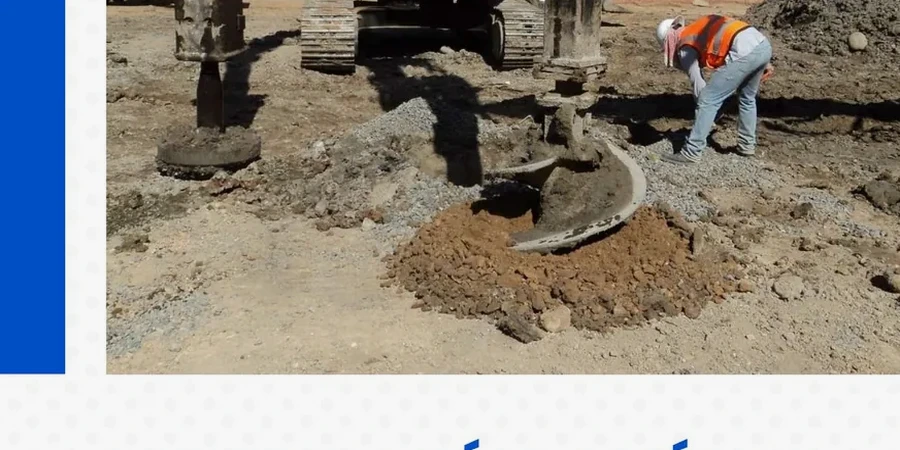
The bottom-feed vibrator rig arrives on a lowboy trailer — a tracked carrier mounting a 130 kW hydraulic power pack and a vibroflot that can develop centrifugal forces exceeding 300 kN at 30 Hz. When the probe penetrates Barrie’s soft clay under its own weight plus water jetting, the real risk is not refusal depth but lateral squeezing: if the clay’s undrained shear strength falls below 15 kPa, the column bore can close before the stone is compacted. In those zones, the installation sequence must alternate primary and secondary columns with a minimum curing window between passes, allowing the pore pressure generated during compaction to dissipate. A second risk — one that has compromised projects along the Lovers Creek floodplain — is stone contamination, where the aggregate mixes with the in-situ clay at the column-soil interface. That weakens the shear transfer mechanism and turns a designed 0.8 m effective diameter into something closer to 0.5 m. The only reliable mitigation is real-time monitoring of amperage during compaction lifts and post-installation CPT soundings through the column centre. Barrie’s seasonal frost penetration, reaching 1.5 m in severe winters, introduces a third concern: the upper portion of the column must extend below the frost-susceptible zone to prevent heave differentials between treated and untreated ground.
Regulatory framework
NBCC 2020 — Part 4, Structural Design, serviceability criteria for settlement, CSA A23.3 — Design of Concrete Structures, foundation interaction requirements, ASTM D5778 — Standard Test Method for Electronic Friction Cone and Piezocone Penetration Testing of Soils, ASTM D448 — Standard Classification for Sizes of Aggregate for Road and Bridge Construction (stone backfill), Priebe, H.J. (1995) — The Design of Vibro Replacement, Ground Engineering
Related services
Settlement Analysis and Column Layout
Calculation of total and differential settlement under service loads using the Priebe method, with finite element modelling for column groups exceeding twelve units. The deliverable includes a dimensioned plan showing column spacing, diameter, depth, and area replacement ratios per grid zone.
Load Test Specification and Interpretation
Development of a field-testing program consistent with ASTM D1143/D1143M for isolated stone columns: reaction frame design, loading increments to 200% of working load, and criteria for acceptance based on load-settlement curves measured with dial gauges and telltales.
Quality Control Protocol During Installation
A construction-phase QC manual covering real-time recording of vibroflot amperage and lift thickness, stone consumption logs, pore pressure monitoring at the perimeter, and pass/fail thresholds for post-installation CPT verification through the column axis.
Typical parameters
Frequently asked questions
What ground conditions in Barrie make stone columns the preferred solution over rigid inclusions or deep foundations?
Stone columns are particularly effective where Barrie\u2019s soft, normally consolidated silty clays extend between 6 and 18 metres depth with undrained shear strengths in the 15 to 50 kPa range. In these profiles, stone columns provide settlement reduction and drainage without the cost of penetrating to bedrock. When the competent till is within 20 metres, a floating column design can satisfy NBCC serviceability limits for most low- to mid-rise structures. If the soft zone exceeds 20 metres or the structural loads require near-zero settlement, we typically recommend evaluating rigid inclusions or driven piles instead.
How is the area replacement ratio determined for a project in Barrie?
The area replacement ratio \u2014 the proportion of the treated ground area occupied by stone columns \u2014 is calculated iteratively from the target settlement reduction. We start with the in-situ compressibility parameters measured from CPT and laboratory consolidation tests on Shelby tube samples, then apply Priebe\u2019s improvement factor to find the ratio that brings total settlement under 25 mm for framed buildings. In Barrie\u2019s south-end clays, ratios of 18 to 25 percent are common; in the stiffer northern till, 12 to 15 percent often suffices. The final layout is checked with a finite element model that accounts for column group interaction and the stiffness contrast between treated and untreated zones at the grid perimeter.
What is the typical cost range for stone column design and installation in Barrie?
A complete stone column treatment in Barrie, including geotechnical investigation, design calculations, sealed report, and installation with quality control testing, typically falls between CA$2,140 and CA$7,860 for the design and engineering component. The installation cost varies significantly with depth, number of columns, and site access constraints. A detailed proposal is prepared after reviewing the existing geotechnical data and the structural loading schedule.