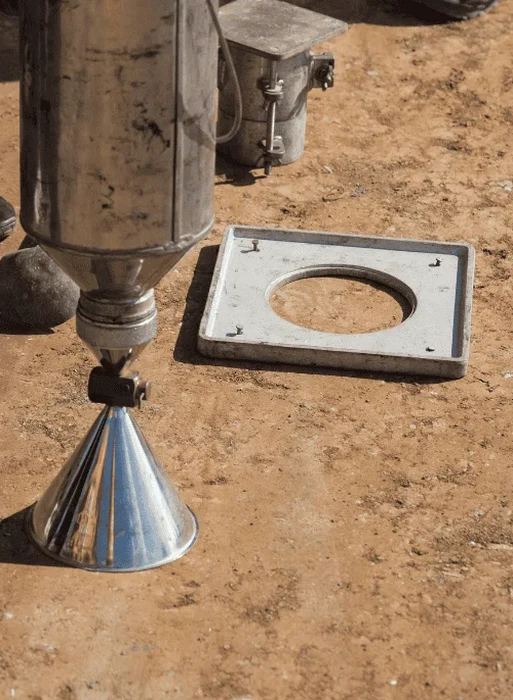
The technician steps out of the truck on a compacted lift near Kempenfelt Bay, carrying a metal base plate, a graduated cylinder of Ottawa sand, and a field scale that has been calibrated that morning. This is the standard setup for the ASTM D1556 sand cone test, and across Barrie’s construction sites it remains the reference method for verifying that soil has been compacted to specification. The procedure looks simple from a distance: dig a precise hole, weigh the excavated material, fill the cavity with sand of known density, and calculate the in-place unit weight. But anyone who has performed the test on Barrie’s silty sand to sandy silt till knows that moisture content, grain size, and the care taken during excavation determine whether the numbers hold up under review. The City of Barrie and consulting engineers routinely specify 95 or 98 percent of Standard Proctor maximum dry density for structural fill, and the sand cone provides the direct physical measurement that nuclear gauges and proof-rolling alone cannot replicate. Before a foundation inspection is signed off or a road base receives asphalt, the sand cone results become the controlling record of compaction quality, which is why the Proctor tests that establish the reference curve must be run on the same material being placed.
The sand cone density method works especially well for the granular and low-cohesion soils that dominate Barrie’s glacial stratigraphy, where cutting a clean hole with vertical sides is feasible. For deeper verification of fill variability or when probing the interface between structural fill and natural ground, many contractors pair the sand cone program with test pits to visually log the stratigraphy while sampling for laboratory confirmation, creating a defensible QA/QC package that satisfies both Ontario Building Code requirements and the project’s geotechnical engineer of record.
In Barrie’s glaciolacustrine silts, a two-percent deviation from optimum moisture content can drop compaction from 98 percent to below 92, making the sand cone the decisive check before cover.
Process and scope
Site-specific factors
Ontario’s Building Code (O. Reg. 332/12) and the referenced CSA A23.3 standard place the responsibility for verifying engineered fill squarely on the designer and the testing agency retained for the project. In Barrie, where a significant portion of new development occurs on lands that were either agricultural or low-lying marsh before grading, the risk of differential settlement beneath slabs and pavements is not theoretical: it has been documented in warranty claims, cracked foundation walls, and premature asphalt distress on collector roads that serve the city’s growing subdivisions. The sand cone test addresses this risk directly by providing a point measurement of achieved density that can be compared against the laboratory compaction curve, and when results fall below the specified threshold, the lift is reworked before the next layer is placed. The most common failure mode the field team encounters is insufficient moisture conditioning, particularly in the silty sands that can look dry and friable even when they are three or four percentage points below optimum. Running a sand cone test immediately after compaction identifies the problem while the contractor can still correct it with water application and re-rolling, rather than discovering low density only after the flexible pavement begins to rut two winters later. Another Barrie-specific consideration is testing during the spring thaw, when fill that was placed and accepted in the previous November may have been exposed to freeze-thaw cycles; re-testing areas that sat over winter before placing structural loads has become standard practice on several institutional projects in the city’s north end.
Regulatory framework
ASTM D1556-15e1: Standard Test Method for Density and Unit Weight of Soil in Place by Sand-Cone Method, ASTM D698-12e2: Standard Test Methods for Laboratory Compaction Characteristics (Standard Proctor), OPSS.MUNI 206: Construction Specification for Grading (Ontario Provincial Standard, municipal version), CSA A23.3-19: Design of Concrete Structures (referenced for foundation bearing on engineered fill)
Related services
Compaction QA/QC Package for Residential Subdivisions
Field density testing on each lift of structural fill using ASTM D1556, paired with Standard Proctor reference curves (ASTM D698) run on representative samples of the borrow material. The package includes GPS-located test records, moisture content determination by oven drying, and a summary report formatted for City of Barrie building permit close-out. Typical coverage is one sand cone test per 500 square meters per compacted lift, with additional frequency at foundation subgrades and utility trench backfill. Results are delivered within 24 hours, with same-day notification when a failed test requires immediate rework.
Trench and Utility Backfill Verification
Sand cone density testing focused on the narrow, hard-to-access zones around sewer, watermain, and storm drainage trenches in Barrie’s municipal right-of-way. The testing protocol follows OPSS.MUNI 206 compaction requirements and includes density measurement at the pipe haunch zone, the springline, and within 300 mm of the finished grade. Because trench backfill in Barrie frequently encounters groundwater at depths of two to three meters near the lake, the service includes moisture monitoring and recommendations for dewatering or material substitution when the placed fill cannot achieve the specified density due to excess water content.
Typical parameters
Frequently asked questions
How much does a sand cone field density test cost in Barrie?
For projects within Barrie and the immediate Simcoe County area, a single sand cone density test typically ranges from CA$140 to CA$220 per point, depending on the number of tests performed on the same day and the travel distance to the site. The rate includes the field technician’s time, the Ottawa sand and calibrated equipment, moisture content determination in the laboratory, and the signed test report. Most subdivision and commercial projects are quoted on a daily or project-wide basis, which reduces the per-test cost when fifteen or more points are taken during one mobilization.
How is the sand cone method different from a nuclear density gauge on a Barrie site?
The sand cone method measures in-place density directly by determining the mass and volume of excavated soil, while a nuclear gauge infers density from the scattering of gamma radiation and requires a soil-specific calibration curve. On Barrie’s silty sands and tills, the nuclear gauge can produce reliable results once calibrated, but when the material contains variable amounts of organic silt or mica, the gauge readings can drift. The sand cone is the referee method specified in OPSS.MUNI 206 when gauge results are in dispute, and it remains the preferred test for final acceptance of structural fill beneath footings and floor slabs.
How many sand cone tests are required for a typical house foundation in Barrie?
The City of Barrie building department generally follows the Ontario Building Code requirement that engineered fill be verified at a frequency of one test per lift per 500 square meters. For a typical single-family home with a full basement, this usually translates to three to five sand cone tests per compacted lift, depending on the footprint. The testing agency submits the results directly to the geotechnical engineer of record, who then provides the foundation inspection sign-off that the city requires before the footing inspection can proceed.
What happens when a sand cone test fails the compaction requirement?
When a field density result comes in below the specified percentage of maximum dry density, the technician marks the failed location with paint on the lift surface and notifies the site supervisor immediately. The typical remedy is moisture conditioning followed by additional roller passes, after which the area is re-tested. In cases where the fill material itself is unsuitable, such as frozen soil or fill containing excess organic matter, the failed material must be removed and replaced with approved borrow. The failed test and the re-test results are both documented in the final report, providing a complete chain of evidence for the municipal inspector.