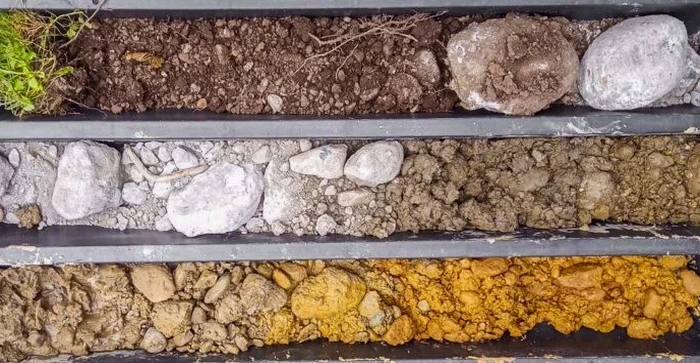
Barrie’s expansion from a key stop on the Nine Mile Portage to a thriving city of over 150,000 has placed increasing demand on its varied glacial soils. The Kempenfelt Bay shoreline and the surrounding drumlin fields create a patchwork of silty tills, sand lenses, and occasional organic deposits that make uniform foundation assumptions risky. We have supported commercial developments along Mapleview Drive and residential subdivisions in the Ardagh Bluffs, where even two adjacent lots can present completely different bearing conditions. An exploratory test pit gives you direct visual access to the strata — far more revealing than a borehole log alone when you need to confirm fill depth, identify buried organics, or assess groundwater ingress at foundation level. Before committing to foundation design, pairing this with grain-size analysis helps quantify the silty sand mixtures that dominate the Oro Moraine, giving you a complete picture of both composition and behavior.
A two-meter exploratory test pit in Barrie reveals more about your foundation conditions than twenty pages of desktop study ever will.
Process and scope
Site-specific factors
Our field crews in Barrie use a tracked mini-excavator or a rubber-tired backhoe, depending on site access, and every pit is benched or sloped back to meet Ontario Regulation 213/91 trench safety requirements before anyone enters. We insist on a utility locate being completed and a signed locate report in hand at least 48 hours before mobilization — the dense network of shallow gas and fiber lines in older Barrie neighborhoods like Allandale makes this non-negotiable. The excavator operator works under the direct guidance of our geotechnical engineer, who calls the final depth once competent bearing strata are confirmed or when groundwater inflow makes further excavation impractical. If the pit walls show signs of instability, we stop, reassess, and document the limitation rather than push through and compromise safety. Every pit is backfilled the same day with mechanical compaction in lifts, and the surface is restored to match the pre-existing grade.
Explanatory video
Regulatory framework
ASTM D2488 — Standard Practice for Description and Identification of Soils (Visual-Manual Procedure), CSA A23.3 — Design of Concrete Structures (foundation references), Ontario Regulation 213/91 — Construction Projects (trench safety), ASTM D420 — Standard Guide for Site Characterization for Engineering Design and Construction Purposes
Related services
Stratigraphic Test Pit Logging
We excavate, log, and photograph each test pit face to ASTM D2488 standards, recording layer thicknesses, moisture conditions, and any fill or organics encountered. You receive a PDF log within 48 hours.
Groundwater and Seepage Assessment
We measure the immediate water strike level and return after 24 hours for a stabilized reading. For sites near Kempenfelt Bay or the Lovers Creek corridor, this data is critical for basement waterproofing design.
Targeted Sampling for Lab Testing
We collect representative disturbed and undisturbed samples from the pit and coordinate rush triaxial, consolidation, or grain-size testing so your design schedule stays on track.
Typical parameters
Frequently asked questions
How much does an exploratory test pit cost in Barrie?
For a standard single-day program with one or two pits in the Barrie area, the cost typically falls between CA$760 and CA$1,160. The final figure depends on access constraints, depth required, sampling complexity, and whether we coordinate supplementary lab testing.
What’s the difference between a test pit and an SPT borehole?
A test pit gives you a direct visual cross-section of the soil — you can see layering, fill, roots, and groundwater seepage with your own eyes. An SPT borehole provides deeper penetration and a numerical N-value. In Barrie’s glacial till, we often recommend a combination: test pits for the upper 3–4 meters to confirm fill and water conditions, and boreholes to prove the deeper bearing stratum.
How do you handle backfill and surface restoration after a test pit?
We backfill the same day using the excavated material, compacting it in lifts with the excavator bucket or a mechanical tamper. The surface is graded to match the surrounding ground, and we document the process. For paved areas or sensitive landscaping, we discuss restoration expectations before mobilization.