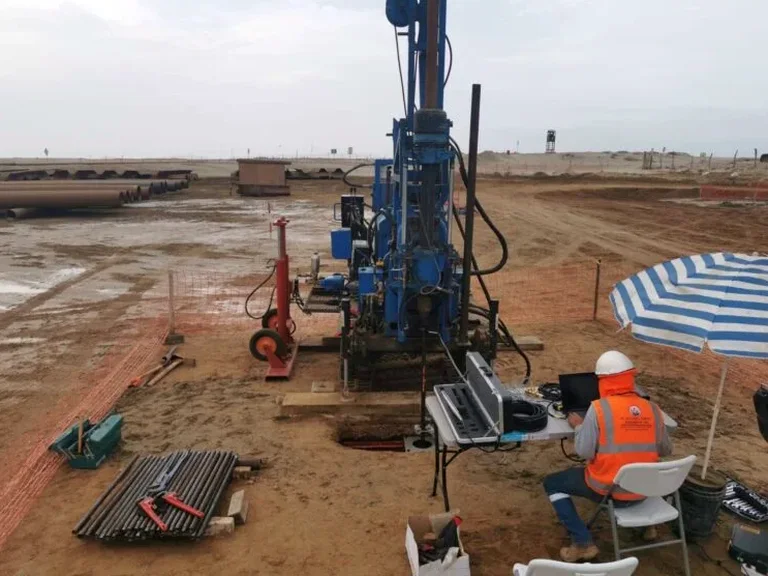
The transition from the limestone plains south of Lake Simcoe to the glaciolacustrine clays of Barrie creates a subsurface environment where standard penetration tests often miss the thin, sensitive silt seams that control drainage and stability. In our experience profiling sites across the city, from the infill zones near Kempenfelt Bay to the drumlinized till uplands in the south end, the cone penetration test provides a continuous signature of soil behavior that no split-spoon sample can match. The deep, compressible glaciomarine deposits left by glacial Lake Algonquin extend in many areas beyond 30 meters, and the CPT rig reads pore pressure dissipation right at the cone face — critical data when you are designing foundations on ground that consolidates slowly under load. For sites where the target is bearing in the underlying till, we often pair CPT soundings with SPT drilling to correlate tip resistance with N-values for local code submissions, and the combined dataset gives the geotechnical engineer a complete picture of both strength and stratigraphy.
A CPT sounding in Barrie's Lake Algonquin clays reads thin silt partings at 2 cm resolution — exactly the layers that control pore pressure dissipation and long-term settlement.
Process and scope
Site-specific factors
One pattern we see repeatedly in Barrie is the misinterpretation of CPT refusal on scattered boulders within the till as the top of competent bedrock. The Newmarket Till here is dense and stony, and a cone that spikes to 50 MPa and then drops back to 15 MPa has almost certainly hit a granitic clast, not the Paleozoic shale basement — a distinction that has real consequences if the pile design assumes a shallower bearing stratum. The soft clay valleys that feed into Kempenfelt Bay also hide buried organic channels, and the CPT friction ratio combined with pore pressure response flags these organics unambiguously where auger cuttings alone would wash out the evidence. Another local reality: winter work in Barrie means the top 0.6 to 1.0 meters of clay crust can be frozen solid, and we pre-drill through the frozen layer before starting the CPT push to avoid cone damage and sensor drift — a practical detail that out-of-town crews sometimes learn the hard way.
Explanatory video
Regulatory framework
ASTM D5778-20: Standard Test Method for Electronic Friction Cone and Piezocone Penetration Testing of Soils, NBCC 2015, Division B, Part 4: Structural Design — geotechnical investigation requirements, CSA A23.3-14: Design of Concrete Structures — reference for pile capacity from CPT, NCEER 1997 Workshop: CPT-based liquefaction triggering procedures (Youd & Idriss 2001 update)
Related services
Piezocone with Dissipation Testing
Full u₂ piezocone profiling with timed dissipation tests at select depths. Provides corrected tip resistance, sleeve friction, pore pressure ratio, and in-situ consolidation coefficients for estimating settlement rates in Barrie's compressible glaciolacustrine clays.
CPT-Based Pile Capacity Analysis
Direct design of driven piles and CFA piles using LCPC (French Road and Bridge Laboratory) and ICP (Imperial College) methods applied to CPT data. Eliminates the need for conservative SPT-based correlations when bearing in the till is the target.
Seismic CPT (SCPT) Add-On
Downhole shear wave velocity measurement at 1-meter intervals during the CPT push. Generates Vs profiles for NBCC site class determination and liquefaction triggering analysis, essential in the high-water-table zones south of Kempenfelt Bay.
Typical parameters
Frequently asked questions
What depth can CPT reach in Barrie's glacial deposits?
In the soft to firm glaciolacustrine clays that dominate much of the city, a 20-tonne penetrometer truck routinely reaches 25 to 35 meters. The limiting factor is usually the dense, stony Newmarket Till beneath the clay sequence; once the cone tip resistance exceeds 40 to 50 MPa consistently, we approach refusal. On sites where the till is shallow — common in the drumlinized uplands — penetration may stop at 10 to 15 meters. We always pre-auger through frozen crust in winter months to avoid damaging the cone sensors.
How much does CPT testing cost for a typical Barrie residential lot?
For a standard single-family lot investigation, a CPT sounding with dissipation tests at two depths typically falls in the range of CA$260 to CA$360 per location, depending on access conditions and total depth. Most residential projects require two to three soundings to capture lateral variability in the clay thickness. The cost per sounding decreases for multi-location commercial or subdivision work.
Is CPT accepted by Barrie building officials for foundation design?
Yes, CPT data is fully accepted under the Ontario Building Code when the testing follows ASTM D5778 and the geotechnical report provides interpreted design parameters. The continuous profile is particularly valued by review engineers for sites in the Lake Simcoe basin because it reveals thin compressible layers that SPT sampling at 1.5-meter intervals can miss. We provide both the raw digital data and interpreted plots with soil behavior type classification per Robertson (2016).
Can CPT detect organic soils and peat in the Barrie area?
CPT is one of the most reliable tools for identifying organic layers because the friction ratio increases sharply in peat and organic silt while the cone tip resistance drops to very low values — typically qc below 0.5 MPa with Rf above 5 percent. In the buried valleys around Kempenfelt Bay, where post-glacial organic accumulation is common, the CPT log pinpoints these layers with far greater precision than auger sampling, which tends to mix the soft organics with the surrounding mineral soil.