A lot of contractors working in Barrie will order a basic concrete cylinder break and call it a day. The problem shows up two years later when a retaining wall on Anne Street starts tilting or a commercial slab in the south end cracks diagonally. The root cause is almost always the same: nobody measured the actual shear strength of the native soil under drained conditions. A standard unconfined compression test on clay gives you a number, sure, but it does not tell you what happens when the water table rises in spring or when the clay consolidates under load over a decade. That is exactly the gap a triaxial test fills. The lab runs the specimen through a controlled stress path that replicates field conditions—saturation, consolidation, and drainage—so the engineer gets cohesion and friction angle values that actually hold up in court and on site. For deep excavations near Kempenfelt Bay, combining triaxial data with a slope stability analysis prevents the kind of failure that costs six figures to remediate.
A CU triaxial test with pore pressure measurement gives you the effective cohesion and friction angle—the two numbers that separate a safe foundation from a lawsuit.
Process and scope
Site-specific factors
Barrie sits at roughly 252 meters above sea level, but the real number that matters for geotechnical risk is the groundwater fluctuation range—up to 3 meters between March and September in some areas near the Lovers Creek watershed. A triaxial test that does not replicate the correct saturation condition is worse than useless; it gives a false sense of security. Soft clay layers in the Barrie area can lose 50% of their undrained shear strength when the water table rises and positive pore pressures build up under rapid loading. Developers who skip the triaxial stage and design off presumptive bearing values from the Ontario Building Code alone are gambling. The 2019 flooding event that washed out several construction excavations in the city was a reminder that drained and undrained behavior are two completely different animals. A consolidated-undrained test with pore pressure measurement tells you exactly where that clay sits on the failure envelope when it counts—during the first heavy rain after the footing is poured. For projects near the waterfront, the lab often recommends pairing the triaxial program with a liquefaction screening if the stratigraphy includes loose saturated sands below the clay crust.
Regulatory framework
ASTM D4767-11 – Standard Test Method for Consolidated Undrained Triaxial Compression Test for Cohesive Soils, ASTM D2850-15 – Standard Test Method for Unconsolidated-Undrained Triaxial Compression Test on Cohesive Soils, ASTM D7181-20 – Standard Test Method for Consolidated Drained Triaxial Compression Test for Soils, CSA A23.3-19 – Design of Concrete Structures (references shear strength parameters for foundation design), Ontario Building Code 2012 (O. Reg. 332/12) – Division B, Part 4, geotechnical design provisions
Related services
Consolidated-Undrained (CU) Triaxial Test with Pore Pressure Measurement
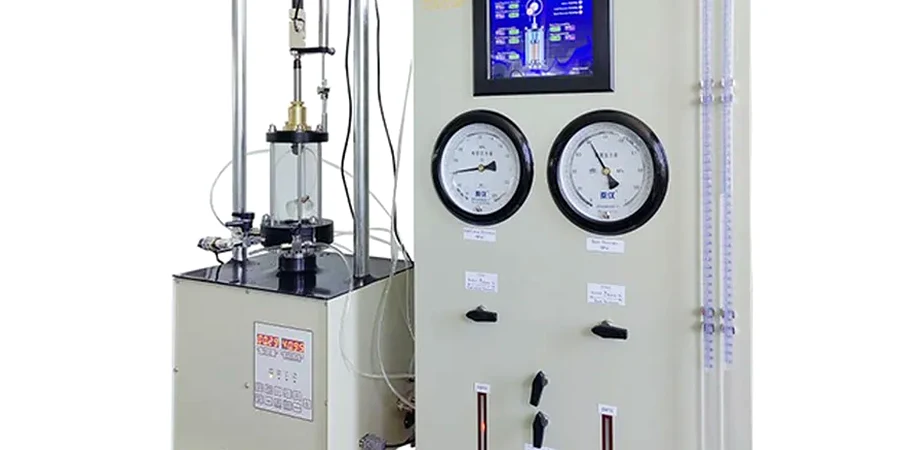
The standard test for long-term stability analysis in Barrie’s silty clays. Specimens are saturated via back-pressure, consolidated to in-situ stress, and sheared undrained while recording excess pore pressure. Outputs effective cohesion (c') and effective friction angle (φ') for use in drained and undrained limit equilibrium models.
Unconsolidated-Undrained (UU) Triaxial Test
A quick-look test for total stress parameters in fine-grained soils. Suitable for short-term bearing capacity checks during construction staging. The lab runs three specimens at different confining pressures and reports undrained shear strength (Su) and total stress envelope.
Consolidated-Drained (CD) Triaxial Test
Required when the loading rate is slow enough that excess pore pressures dissipate—common for granular fills and long-term embankment loading. The specimen is consolidated and sheared at a rate slow enough to allow full drainage, yielding drained friction angle (φ'd) and cohesion intercept for permanent works design.
Typical parameters
Frequently asked questions
How much does a triaxial test cost for a Barrie project?
A standard triaxial test program in Barrie typically runs between CA$2,390 and CA$4,020, depending on the number of specimens and the test type—CU with pore pressure measurement costs more than a basic UU test. The price includes specimen trimming, saturation with B-value verification, consolidation, shearing, and the final engineering report with Mohr-Coulomb parameters. For a full geotechnical investigation, most projects run three specimens per test type to define a reliable failure envelope.
What is the difference between UU, CU, and CD triaxial tests?
The three types differ in drainage conditions during consolidation and shearing. UU (unconsolidated-undrained) tests apply confining pressure and shear the specimen without allowing drainage—useful for short-term bearing capacity in clay. CU (consolidated-undrained) tests consolidate the specimen first, then shear it undrained while measuring pore pressure; they yield effective stress parameters for slope stability and settlement analysis. CD (consolidated-drained) tests consolidate and shear the specimen slowly enough that no excess pore pressure builds up, giving drained parameters for granular soils and long-term embankment loading.
How long does a triaxial test program take from sample to report?
A set of three triaxial specimens typically takes 5 to 7 business days from sample receipt to final report. CU tests with pore pressure measurement require longer saturation and consolidation stages—sometimes up to 48 hours for low-permeability Barrie clays—while UU tests can be completed faster. Expedited turnaround is available for construction deadlines.
What soil types in Barrie benefit most from triaxial testing?
Triaxial testing is most valuable for the soft to firm silty clays and glaciolacustrine deposits common across Barrie, particularly in the Holly, Allandale, and Painswick areas. These soils often show significant pore pressure development during shearing that unconfined compression tests completely miss. Glacial till with high silt content also benefits, especially when the project involves deep excavations or retaining walls where drained friction angle governs the design.
Is triaxial testing required by the Ontario Building Code for foundation design?
The Ontario Building Code (O. Reg. 332/12) requires foundation design to be based on a geotechnical investigation that determines soil strength parameters appropriate for the loading condition. For cohesive soils in Barrie, where undrained and drained behavior differ substantially, triaxial testing is the recognized method to satisfy this requirement. Empirical correlations from SPT blow counts are not accepted as a substitute when the structure falls under Part 4 design provisions, particularly for deep foundations, slopes, and retaining walls over 1.2 meters in height.