Barrie's transformation from a key stop on the Nine Mile Portage to one of Canada's fastest-growing cities has placed unprecedented demand on its underground infrastructure. The push for downtown intensification, particularly around the waterfront and the Allandale core, means developers are routinely going three or four levels below grade on sites that were farmland just a generation ago. What they encounter below the surface is a complex legacy of the Last Glacial Maximum: dense, stony Simcoe till overlying fractured limestone bedrock. Designing a shoring system here is not a template exercise, because a test pit program often reveals erratic boulders and sand lenses within the till that can redirect groundwater flow and create localized instability at the excavation face. The engineering challenge is to balance the city's ambitious growth with the rigorous constraints imposed by its post-glacial geology.
In Barrie's glacial till, anchor bond capacity often exceeds design predictions, but the real risk lies in the undetected sand lens that connects the excavation base to Kempenfelt Bay.
Process and scope
Site-specific factors
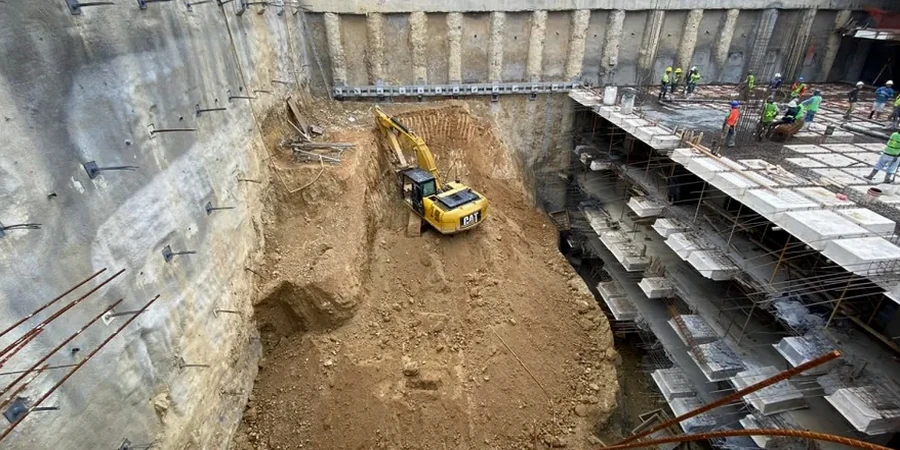
The contrast between a deep dig in Barrie's historic Allandale neighborhood and one up near the Georgian College corridor illustrates the risk perfectly. In Allandale, the till is often thin and the underlying bedrock is riddled with karst-like solution channels that can suddenly drain groundwater, leading to rapid drawdown and potential settlement of adjacent century-old structures. A few kilometers north, the till thickens substantially but contains interbedded silty zones that are highly susceptible to boiling when the excavation base is cut below the water table. In both scenarios, the biggest concern is not just wall deflection but the secondary effects: a support strut being overstressed by a migrating soil wedge, or a buried utility fracturing because the ground movement was concentrated in a narrow settlement trough behind the soldier pile and lagging. This is why design assumptions must be verified continuously during construction.
Regulatory framework
National Building Code of Canada (NBCC) 2020, Part 4, CSA A23.3-19: Design of Concrete Structures, PTI DC-35.1-14: Recommendations for Prestressed Rock and Soil Anchors
Related services
Site Investigation and Soil Parameterization
We design and supervise a targeted field program that goes beyond the standard borehole log. This includes seismic cone penetration testing to identify loose silt zones, packer testing in bedrock to measure hydraulic conductivity, and laboratory triaxial testing (CIU and CAU) on undisturbed till samples to define effective stress strength envelopes. The output is a solid geotechnical model that captures the spatial variability of the Simcoe till across the building footprint.
Shoring Design and Construction-Phase Engineering
The design package includes detailed calculation of earth pressure distributions for staged excavation, finite element analysis of wall and ground deformation, and structural design of all temporary steel elements including walers, struts, and corner braces. We remain engaged during construction to review instrumentation data from inclinometers and load cells, confirming that the observed performance aligns with the predicted behavior and adjusting the anchor lock-off loads if necessary.
Typical parameters
Frequently asked questions
How is the risk of basal heave assessed for a deep excavation in Barrie's silty till?
Basal heave is evaluated using bearing capacity methods that account for the undrained shear strength of the till at the subgrade level. We run total stress analyses for short-term conditions, comparing the calculated factor of safety against the minimum values specified in the NBCC and the Ontario Building Code. If a soft silt layer is present within the zone of influence, the model is extended to check for a deep-seated failure surface that could daylight beyond the excavation footprint.
What is the typical cost range for a geotechnical design of a deep excavation in Barrie?
The engineering design fee typically ranges from CA$2,830 for a straightforward single-tier tieback system on a compact site, up to CA$10,800 for a complex multi-level shoring design involving raker supports, corner braces, and detailed building settlement analysis for adjacent heritage structures.
Can the design be adapted if we encounter unexpected boulders during soldier pile installation?
Yes, this is a common occurrence in the Simcoe till. The design includes a contingency protocol for refusal conditions. If a boulder prevents pile driving to the design tip elevation, we can either pre-drill through the obstruction or, if it is a large erratic, analyze the reduced embedment and compensate with an additional anchor level or a reinforced concrete plug between the piles.
How do you protect adjacent buildings from vibration damage during pile driving?
We establish vibration criteria based on the structural condition and foundation type of each adjacent building, referencing CSA S832 and the DIN 4150-3 standard. Pre-construction condition surveys are mandatory. If the predicted peak particle velocity from driving exceeds the threshold, we specify pre-augering to reduce soil resistance or switch to a vibratory hammer with real-time monitoring.
What is the design life assumed for the temporary shoring system?
Temporary shoring for a typical Barrie excavation is designed for a service life of 18 to 24 months, which covers the excavation, foundation construction, and backfilling sequence. The design accounts for the seasonal effects of freeze-thaw on the exposed lagging and the potential for anchor preload relaxation during spring thaw, with a specified re-stressing program if the excavation remains open through a second winter.